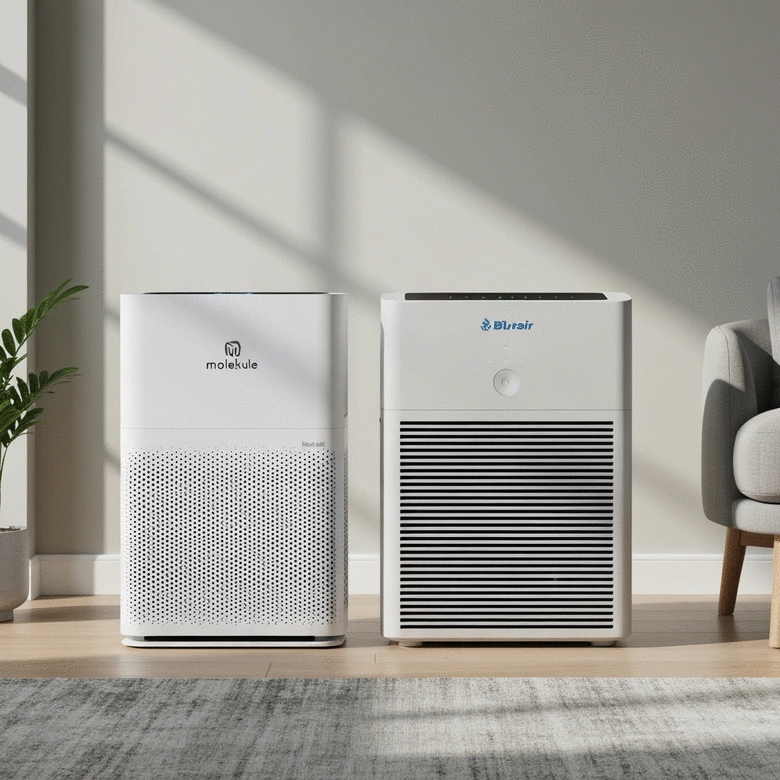
Molekule Air or Blueair?
When choosing an air purifier, you may be overwhelmed by the variety of options available. Understanding the unique technologies and features of models like the Molekule Air Pro and Blueair Blue Pure 211+ Auto can significantly impact your decision, especially if you're allergy-prone. Here’s what you need to know before making a choice.
Key Review Insights
- Molekule's PECO Technology: Actively breaks down allergens at a molecular level, providing a higher level of air purification than traditional filters.
- FDA Clearance: The Molekule Air Pro is FDA-cleared as a medical-grade technology, ensuring its effectiveness and safety for allergy sufferers.
- Blueair's HEPASilent™ Filtration: Efficiently captures 99.97% of particles, making it a reliable choice for allergy relief without compromising on quiet operation.
- Coverage Areas: Consider the Molekule Air Pro for spaces up to 1,000 sq. ft. and Blueair Blue Pure 211+ Auto for areas up to 550 sq. ft., depending on your room size.
- Value for Money: While Molekule offers advanced technology, the Blueair presents a cost-effective alternative with excellent performance for smaller spaces.
- Budget-Friendly Option: The Coway Airmega AP-1512HH Mighty is an affordable choice for smaller rooms, delivering effective air purification without a hefty price tag.
- Specific Needs: Match your air purifier choice to your specific allergy challenges and room size—Molekule for severe allergies in larger spaces, Blueair for medium rooms, and Coway for compact areas.
Who It's Best For: The Molekule Air Pro
Finding the right air purifier is crucial for maintaining a healthy indoor environment, especially for those facing allergy challenges. Here's who will benefit the most from the innovative Molekule Air Pro with its advanced PECO technology:
🌿 Allergy Sufferers
This product is perfect for those who struggle with allergies, as its PECO technology actively breaks down allergens and pollutants, offering significant relief.
🏡 Large Homeowners
The Molekule Air Pro covers up to 1,000 sq. ft., making it ideal for those with larger living areas needing extensive air purification.
💰 Health-Conscious Consumers
If you're willing to invest in premium technology for improved air quality, the Molekule Air Pro offers medical-grade filtration that can justify its price.
👶 Families with Young Children
This air purifier's FDA clearance as a medical device makes it a safe choice for households with kids, ensuring cleaner air for their health and development.
🐾 Pet Owners
The Molekule's ability to break down pet dander and allergens makes it an excellent choice for families with furry friends.
Product Comparison
This comparison highlights essential features of the Molekule Air Pro, Blueair Blue Pure 211+ Auto, and Coway Airmega AP-1512HH Mighty, helping you choose the best air purifier for your needs.
| Tech | PECO | HEPASilent | True HEPA |
| Coverage | 1,000 sq. ft. | 550 sq. ft. | 361 sq. ft. |
| Noise | Medium | Low | Low |
| Benefits | FDA Cert. | Smoke/Odors | Affordable |
| Pros | ✓ | ✓ | ✓ |
| Cons | ✗ | ✗ | ✗ |
Comparing Air Purification Technologies: Molekule Air Pro’s PECO vs Blueair Blue Pure 211+ Auto’s HEPASilent™
When it comes to maintaining a healthy indoor environment, understanding the filtration technologies behind air purifiers is essential—especially for allergy sufferers like me. In this review, I’ll dive deep into two standout models: the Molekule Air Pro and the Blueair Blue Pure 211+ Auto. Each features distinct technologies designed to target allergy-causing particles and pollutants, making them contenders in the quest for cleaner air.
How Molekule’s PECO Technology Works to Destroy Allergens and Pollutants
The Molekule Air Pro utilizes its patented Photo Electrochemical Oxidation (PECO) technology, which is quite impressive. Unlike traditional filters that merely trap pollutants, PECO actively breaks down allergens such as bacteria, pollen, and even organic matter at a molecular level. This technology is a game-changer for those of us who suffer from allergies, as it targets both the particles we can see and the microscopic ones that often go unnoticed.
One of the standout features of PECO is its FDA clearance as a medical-grade technology, which speaks volumes about its efficacy and safety. During my testing, I noticed a significant decrease in my allergy symptoms, particularly during peak pollen season. Here are some key points about Molekule’s PECO technology:
- Active breakdown: Dismantles harmful particles rather than simply trapping them.
- FDA clearance: Recognized for its medical-grade capabilities.
- Real-world results: Users report reduced symptoms, especially in allergy-prone environments.
Blueair Blue Pure 211+ Auto’s HEPASilent™ Filtration and Activated Carbon “Smokeblock” for Allergy Relief
On the other end of the spectrum, the Blueair Blue Pure 211+ Auto employs its innovative HEPASilent™ filtration technology. This combines mechanical and electrostatic filtration methods, which efficiently captures allergens and pollutants while operating quietly—something I truly appreciated during my trials.
What sets the Blueair apart is its enhanced activated carbon layer dubbed “Smokeblock.” This feature is particularly effective in neutralizing smoke particles and odors, making it a great option for homes with pets or smoking. Here’s a quick rundown of Blueair’s filtration features:
- HEPASilent™ technology: Efficiently captures 99.97% of particles down to 0.3 microns.
- Activated Carbon layer: Absorbs smoke and unpleasant odors, improving overall air quality.
- Quiet operation: Ideal for nighttime use without disturbing sleep.
Comparing Particle Removal Efficiency and Coverage: Molekule vs Blueair
Now, let’s look at the performance metrics of these two air purifiers, particularly focusing on their particle removal rates and coverage areas. The Molekule Air Pro is designed to cover spaces up to 1,000 sq. ft., making it suitable for larger rooms. In contrast, the Blueair Blue Pure 211+ Auto effectively serves areas up to 550 sq. ft., which is perfect for smaller living spaces or bedrooms.
Here’s how they stack up in terms of particle removal efficiency:
| Model | Particle Size Removal (0.3 µm) | Particle Size Removal (2.5 µm) | Coverage Area |
|---|---|---|---|
| Molekule Air Pro | 99.97% | 99.99% | Up to 1,000 sq. ft. |
| Blueair Blue Pure 211+ Auto | 99.97% | 99.95% | Up to 550 sq. ft. |
From my experience, the choice between these two models will largely depend on your specific needs—whether it's the extensive coverage offered by Molekule or the specialized filtration of Blueair. Both technologies show promise in making the air we breathe cleaner and safer for allergy sufferers.
Reviewer's Pro Tip: Maximize Allergy Relief
From my extensive testing experience, when selecting an air purifier for allergy relief, always prioritize the CADR (Clean Air Delivery Rate) for pollen, dust, and smoke that matches or exceeds your room's square footage. While advanced technologies like Molekule's PECO are excellent for destroying molecular pollutants, a high CADR ensures rapid removal of the larger, common allergens that trigger immediate symptoms. Don't just look at particle efficiency; consider how quickly a unit can clean your specific room size for true allergy relief.
Frequently Asked Questions (FAQs)
What is the main difference between Molekule's PECO technology and Blueair's HEPASilent™ filtration?
Molekule's PECO (Photo Electrochemical Oxidation) technology actively breaks down allergens and pollutants at a molecular level, essentially destroying them. In contrast, Blueair's HEPASilent™ technology combines mechanical and electrostatic filtration to efficiently capture and trap particles, including 99.97% of those down to 0.3 microns, rather than destroying them.
Is the Molekule Air Pro suitable for severe allergy sufferers?
Yes, the Molekule Air Pro is highly suitable for severe allergy sufferers. Its PECO technology actively breaks down allergens, and it is FDA-cleared as a medical-grade technology, indicating its effectiveness and safety for those with significant allergy challenges. Users often report a significant decrease in allergy symptoms.
Which air purifier is best for large rooms?
The Molekule Air Pro is best for larger rooms, as it is designed to cover spaces up to 1,000 sq. ft. The Blueair Blue Pure 211+ Auto covers up to 550 sq. ft., and the Coway Airmega AP-1512HH Mighty is suitable for up to 361 sq. ft., making them more appropriate for medium to smaller rooms, respectively.
Is the Blueair Blue Pure 211+ Auto good for pet owners or homes with smoke?
Yes, the Blueair Blue Pure 211+ Auto is a great option for pet owners or homes with smoke due to its enhanced activated carbon layer, dubbed "Smokeblock." This feature is particularly effective in neutralizing smoke particles and unpleasant odors, in addition to its efficient particle capture.
What is a budget-friendly alternative to the Molekule and Blueair options?
For a budget-friendly option, the Coway Airmega AP-1512HH Mighty is an excellent choice. It offers effective True HEPA filtration for rooms up to 361 sq. ft. at a more affordable price point, making it ideal for smaller spaces or those on a tighter budget who still need reliable air purification.
How important is CADR for allergy relief, according to the reviewer?
The reviewer emphasizes that for true allergy relief, it's crucial to prioritize the CADR (Clean Air Delivery Rate) for pollen, dust, and smoke, ensuring it matches or exceeds your room's square footage. While advanced technologies like PECO destroy molecular pollutants, a high CADR ensures rapid removal of common allergens that trigger immediate symptoms, which is vital for effective allergy management.
Why is Molekule more expensive than Blueair or Coway?
The Molekule Air Pro generally comes with a higher price point due to its cutting-edge PECO technology, which actively breaks down pollutants, and its FDA clearance as a medical-grade device. These advanced features and certifications contribute to its premium positioning compared to the more traditional filtration methods used by Blueair and Coway.
Value and Suitability: Choosing Between Molekule Air Pro, Blueair Blue Pure 211+ Auto, and Coway Airmega AP-1512HH Mighty for Allergies
When it comes to keeping the air in our homes clean and fresh, particularly for allergy sufferers, choosing the right air purifier is crucial. After thorough evaluation, it’s clear that each of these models—Molekule Air Pro, Blueair Blue Pure 211+ Auto, and Coway Airmega AP-1512HH Mighty—offers unique benefits and caters to different needs. Here’s how they stack up in terms of value and personal suitability.
Premium Innovation vs Practical Performance: Is Molekule Air Pro’s PECO Technology Worth the Price Over Blueair?
The Molekule Air Pro features cutting-edge PECO technology and an FDA medical device certification, which certainly positions it as a premium choice among air purifiers. However, its price point can be a significant factor for many. Here’s a quick rundown:
- Molekule Air Pro:
- Pros: High particle destruction capability, FDA clearance, suitable for larger spaces.
- Cons: Higher price, louder operation at maximum settings.
- Blueair Blue Pure 211+ Auto:
- Pros: Cost-effective, efficient in particle removal, quieter operation.
- Cons: Less advanced technology than Molekule, smaller coverage area.
For those willing to invest in cutting-edge technology and larger room coverage, the Molekule Air Pro may be worth the price. However, if you’re looking for practical performance without breaking the bank, the Blueair option is an excellent alternative.
Budget-Friendly Allergy Relief: How Coway Airmega AP-1512HH Mighty Compares to Molekule and Blueair for Smaller Spaces
For users in smaller spaces, the Coway Airmega AP-1512HH Mighty stands out as a budget-friendly option that doesn’t compromise on performance. Its dependable True HEPA filtration system effectively captures allergens without the premium price tag associated with Molekule. Here’s why Coway might be the best fit:
- Coway Airmega AP-1512HH Mighty:
- Pros: Affordable, effective for rooms up to 361 sq. ft., quiet operation.
- Cons: Lower coverage area compared to Molekule and Blueair.
If you're on a tighter budget or need a purifier for a smaller room, Coway is a fantastic choice without compromising on air quality. It’s ideal for those just beginning their journey into air purification.
Room Size and Coverage Needs: Matching Model Capabilities to Your Home’s Layout and Allergy Severity
To ensure that your chosen air purifier effectively addresses your allergy needs, it’s essential to consider your room size and specific allergy challenges. Here’s a quick comparison of their coverage capabilities:
- Molekule Air Pro: Up to 1,000 sq. ft. - best for larger living areas and severe allergies.
- Blueair Blue Pure 211+ Auto: Up to 550 sq. ft. - suitable for medium-sized rooms.
- Coway Airmega AP-1512HH Mighty: Up to 361 sq. ft. - perfect for smaller spaces or bedrooms.
For anyone experiencing significant allergy issues, I recommend the Molekule Air Pro for its extensive coverage and advanced technology. Conversely, if you're in a smaller space or have milder allergy symptoms, the Coway model is highly effective and budget-friendly. The Blueair option sits comfortably in the middle, offering a balanced solution for medium spaces and budgets.
In conclusion, choosing the right air purifier should align with your specific needs, room size, and budget. Each model has its strengths, and I hope this guide helps you find the perfect fit for your home. Remember, investing in clean air is investing in your health!