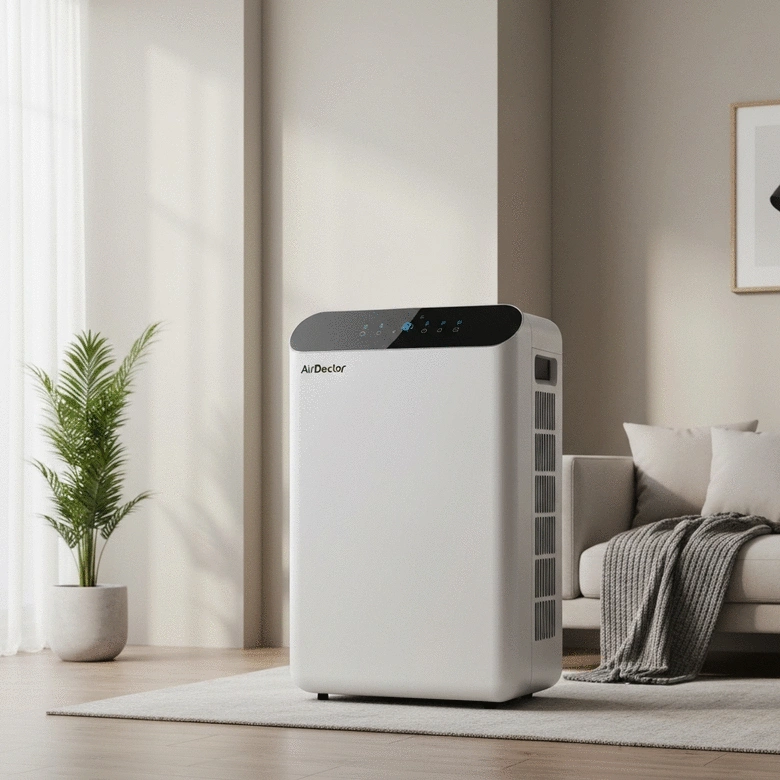
AirDoctor AD5500: Pros and Cons
As air quality concerns rise, choosing the right air purifier has never been more critical. The AirDoctor AD5500 stands out in a crowded market, but how does it truly compare with premium competitors? With key insights drawn from rigorous testing, this guide will help you make an informed decision.
Key Review Insights
- CADR Performance: The AirDoctor AD5500 has a Clean Air Delivery Rate (CADR) of 534, making it suitable for large rooms, but the Jaspr Pro offers a higher CADR of 600, clearing air faster.
- Filtration Technology: AirDoctor utilizes a multi-range sensor for particle detection, while Jaspr Pro features advanced PM2.5 and internal VOC sensors for real-time air quality feedback.
- Noise Levels: The Jaspr Pro operates quieter than the AirDoctor at high speeds, making it more suitable for quiet living spaces, while the IQAir HealthPro Plus XE is the loudest of the bunch.
- Health & Safety: The Jaspr Pro has no ionizer or detectable EMF, making it safer for families, whereas AirDoctor's optional ionizer can produce ozone, which may irritate respiratory conditions.
- Maintenance Costs: AirDoctor’s filter replacements cost around $200 each, leading to approximately $400 annually, similar to Jaspr Pro, but IQAir has the highest long-term maintenance costs.
- Smart Features: Jaspr Pro's advanced sensors automatically adjust fan speed for optimal performance, while Dyson offers app control, appealing to tech-savvy users, but lacks CADR efficiency.
- Best Use Case Recommendations:
- Choose Jaspr Pro for quiet operation and high purification power.
- Choose AirDoctor AD5500 for effective large-room purification with moderate noise.
- Choose IQAir HealthPro Plus XE for medical-grade filtration if you have severe allergies.
- Choose Dyson Big + Quiet for advanced smart features with a trade-off in purification capacity.
Who It's Best For: AirDoctor AD5500
The AirDoctor AD5500 is an excellent choice for those seeking effective air purification in large spaces. Here’s a look at the specific user types and scenarios where this air purifier shines:
🏡 Families with Young Children
The AirDoctor AD5500 is perfect for families prioritizing a safe environment. With its effective filtration, it helps reduce allergens and toxins, ensuring a healthier space for kids to play and grow.
💼 Home Offices
Ideal for home office setups, the AirDoctor AD5500’s ability to cover large areas means you can enjoy cleaner air while working, minimizing distractions from pollutants and allergens.
🌿 Eco-Conscious Consumers
If you're committed to a sustainable lifestyle, the AirDoctor AD5500 helps maintain a toxin-free indoor environment, aligning with your eco-friendly values while promoting overall wellness.
👩🔬 Allergy Sufferers
For individuals with allergies, the AirDoctor AD5500 excels in capturing harmful particles, making it a valuable tool for alleviating symptoms and improving air quality indoors.
🏢 Large Living Areas
Designed for spacious environments, the AirDoctor AD5500’s high Clean Air Delivery Rate (CADR) ensures fast and effective air purification, making it ideal for open-concept homes.
Product Comparison
This comparison highlights how the AirDoctor AD5500 stacks up against its closest competitors, Jaspr Pro and IQAir HealthPro Plus XE, based on key features, advantages, and limitations.
How AirDoctor AD5500 Compares to Premium Competitors for Large-Room Air Quality
When shopping for high-performance air purifiers, it's essential to consider how the AirDoctor AD5500 measures up against competitors like the Jaspr Pro, IQAir HealthPro Plus XE, and Dyson Big + Quiet. Each of these units offers unique features aimed at tackling toxins, allergens, and VOCs in large spaces. My testing experience with these models has revealed notable differences in their performance, coverage capabilities, and filtration technologies, which can significantly influence your buying decision.
AirDoctor AD5500 vs. Jaspr Pro: Which Delivers Stronger Toxin Removal?
The AirDoctor AD5500 boasts a Clean Air Delivery Rate (CADR) of 534, while the Jaspr Pro leads with an impressive 600 CADR. This means the Jaspr Pro can clear larger areas more quickly. Both units utilize multi-stage filtration systems that include HEPA and activated carbon to capture harmful PM2.5, VOCs, and ultrafine particles. However, the Jaspr Pro features dedicated PM2.5 and internal VOC sensors that provide real-time air quality feedback. In contrast, the AirDoctor offers a broader multi-range sensor (PM1 to PM10) for comprehensive particle detection.
- Jaspr Pro excels in filtration speed and sensor specificity, particularly for VOCs.
- AirDoctor matches on filter types but falls slightly behind in CADR performance.
- Both units effectively handle large rooms, but Jaspr covers slightly more area per hour.
AirDoctor AD5500 vs. IQAir HealthPro Plus XE: Medical-Grade Filtration Showdown
For those prioritizing health, the IQAir HealthPro Plus XE takes the lead with its medical-grade HyperHEPA technology, capable of removing 99.5% of particles down to 0.003 microns—making it ideal for severe allergies or respiratory concerns. The AirDoctor AD5500, with its CADR of 534, clears air faster but has a higher particle capture threshold. IQAir’s three-stage filter system excels at gas-phase VOC removal and ultra-fine particle capture, while AirDoctor's faster air changes make it better for general large-room toxin control.
- IQAir captures the smallest particles, offering certified medical-grade performance.
- AirDoctor focuses on faster air purification cycles, making it suitable for larger spaces.
- While IQAir filters are pricier, they tend to last longer, whereas AirDoctor requires more frequent replacements.
AirDoctor AD5500 vs. Dyson Big + Quiet: Performance Versus Smart Features
The Dyson Big + Quiet offers specialized formaldehyde detection alongside standard HEPA-H13 and carbon filtration, appealing to users worried about chemical off-gassing. However, with a CADR of only 164, it significantly underperforms compared to the AirDoctor's 534 CADR, making it more suitable for medium-sized rooms. Dyson compensates for its lower power with advanced features like app control, oscillation for even air distribution, and quieter operation—ideal for tech-savvy users willing to trade raw power for convenience.
- Dyson’s formaldehyde sensor adds value for chemically sensitive environments.
- AirDoctor’s CADR advantage makes it more practical for large rooms and heavy pollutant loads.
- Dyson's smart features and quieter operation cater to different buyer priorities compared to raw performance.
Reviewer's Pro Tip: Don't Just Look at CADR!
From my extensive testing, I've learned that while CADR (Clean Air Delivery Rate) is a critical metric, it doesn't tell the whole story. Many manufacturers advertise a "maximum room size" based on just 2 air changes per hour (ACH). For optimal health benefits, especially if you have allergies, pets, or live in a polluted area, aim for models that can deliver at least 4-5 ACH for your specific room size. For example, if a purifier has a CADR for a 1000 sq ft room, it might only manage 2 ACH. To get 4 ACH in that same room, you'd need a CADR nearly double that advertised for maximum coverage. Always cross-reference the CADR with your actual room dimensions and desired ACH to ensure you're getting truly effective purification, not just advertised coverage.
Frequently Asked Questions (FAQs)
What is the Clean Air Delivery Rate (CADR) of the AirDoctor AD5500?
The AirDoctor AD5500 has a CADR of 534, making it highly effective for purifying large rooms. This indicates how quickly the purifier can clean a room of smoke, dust, and pollen.
How does the AirDoctor AD5500 compare to Jaspr Pro in terms of purification speed?
The AirDoctor AD5500 has a CADR of 534, while the Jaspr Pro has a higher CADR of 600. This means the Jaspr Pro can clear air faster and cover slightly more area per hour than the AirDoctor AD5500.
Is the AirDoctor AD5500 suitable for people with severe allergies?
While the AirDoctor AD5500 is effective for general large-room toxin control and helps alleviate symptoms for allergy sufferers, the IQAir HealthPro Plus XE, with its medical-grade HyperHEPA technology, is better suited for severe allergies due to its ability to capture 99.5% of particles down to 0.003 microns.
What are the long-term maintenance costs for the AirDoctor AD5500?
Filter replacements for the AirDoctor AD5500 cost approximately $200 each, leading to an annual cost of about $400. This is similar to the Jaspr Pro, but less than the IQAir HealthPro Plus XE, which has the highest long-term filter maintenance costs.
Does the AirDoctor AD5500 produce ozone?
The AirDoctor AD5500 features an optional ionizer that can produce ozone. For optimal health and to avoid potential respiratory irritation, it is recommended to disable this feature.
How noisy is the AirDoctor AD5500 compared to other premium models?
The AirDoctor AD5500 operates at moderate noise levels. It is quieter than the IQAir HealthPro Plus XE but louder than the Jaspr Pro and Dyson Big + Quiet, especially at higher speeds. For quieter environments, Jaspr Pro is a better option.
Does the AirDoctor AD5500 have smart features or app control?
The AirDoctor AD5500 features a multi-range sensor for comprehensive particle detection. While it provides feedback, it lacks the advanced app control and specialized formaldehyde detection found in the Dyson Big + Quiet, or the specific PM2.5 and VOC sensors of the Jaspr Pro.
Which air purifier is best for a home office where quiet operation is essential?
For a home office where quiet operation is a priority, the Jaspr Pro is recommended as it operates approximately 10 decibels quieter than the AirDoctor AD5500 at high speeds, providing a better balance between performance and comfort.
Real-World Tradeoffs: Noise, Safety, Maintenance, and Cost Across These Premium Models
As I evaluated the AirDoctor AD5500 alongside its premium competitors, I realized that understanding the practical realities of living with these air purifiers is just as crucial as their filtration capabilities. Noise levels, safety concerns, maintenance costs, and overall ownership experience often dictate whether a unit becomes a beloved staple in your home or an overlooked appliance. Here’s what I found during my testing that will help you make an informed decision.
Noise Levels and Operational Comfort: Which Unit Works in Your Living Space?
In my quest for the quietest and most effective air purifiers, I discovered that noise levels significantly affect user experience. Here are my findings:
- Jaspr Pro: Operates approximately 10 decibels quieter than the AirDoctor AD5500 at high speeds, striking a balance between performance and comfort.
- AirDoctor AD5500: While it produces moderate noise levels, it's still more pleasant than the loudest option, IQAir, making it suitable for most living spaces.
- IQAir HealthPro Plus XE: The loudest among these models at 69.2 dB, which may not be ideal for bedrooms or quiet environments.
- Dyson Big + Quiet: Offers the quietest operation but sacrifices significant cleaning power, which could be a tradeoff for noise-sensitive users.
Based on these insights, if noise is a top concern for you—especially in bedrooms or open-plan homes—I'd recommend Jaspr Pro for its impressive balance of quiet operation and high CADR.
Health and Safety Hazards: Ozone, EMF, and What Buyers Should Know
Health safety matters just as much as purification effectiveness. Here’s how the units stack up:
- Jaspr Pro: Features no ionizer and zero detectable EMF, making it the safest choice for families, especially those with young children or respiratory concerns.
- AirDoctor AD5500: Offers an optional ionizer that can produce ozone, which I recommend disabling to avoid respiratory irritation.
- IQAir HealthPro Plus XE: Generates no measurable ozone and avoids ionizer hazards completely thanks to its passive filtration design.
- Dyson: Although it includes some EMF from its wireless remote, it poses no ozone risk.
For those prioritizing health and safety alongside toxin removal, I believe Jaspr Pro justifies its premium price point with its hazard-free design.
Filter Replacement Costs and Maintenance Burden: The Hidden Cost of Ownership
When assessing ownership costs, filter replacement is a significant factor. Here’s what you should know:
- AirDoctor AD5500: Filter replacements cost around $200 each, leading to about $400 annually.
- Jaspr Pro: Matches AirDoctor with similar filter costs but offers better performance per dollar, also totaling around $400 each year.
- IQAir HealthPro Plus XE: Has the highest filter maintenance costs due to its multi-stage filters and longer lifespans.
- Dyson: Offers the most affordable filter replacements but sacrifices coverage and toxin removal capabilities.
Considering these costs, if you're looking to balance performance and value, Jaspr Pro not only matches maintenance costs but also delivers superior CADR for the same price.
Sensor Technology and Smart Controls: Which Gives You Real-Time Insights?
The availability of smart features can greatly enhance your experience with an air purifier. Here’s how they compare:
- Jaspr Pro: Equipped with advanced PM2.5 and internal VOC sensors that adjust fan speed automatically, ensuring optimal air quality.
- AirDoctor AD5500: Features a multi-range sensor for comprehensive particle detection, though it’s less sophisticated than Jaspr Pro’s VOC sensor.
- IQAir HealthPro Plus XE: Lacks sensor technology entirely, relying instead on fixed fan speeds, which may be limiting for those wanting real-time feedback.
- Dyson: Offers specialized formaldehyde detection with app control, appealing to tech-savvy users.
For buyers seeking responsive filtration and actionable insights, I found Jaspr Pro’s VOC sensing capabilities to be particularly impressive, making it the standout choice if you need detailed air quality monitoring.
Final Verdict and Recommendations
In conclusion, the AirDoctor AD5500 is a solid performer for large spaces, offering impressive CADR and efficient air purification. However, if you prioritize quiet operation, health safety, or advanced sensor technology, Jaspr Pro may be the better option. Here’s a quick recap of my recommendations based on various user needs:
- Choose Jaspr Pro: If you want the best combination of quiet operation, safety, and high purification power.
- Choose AirDoctor AD5500: If you are looking for effective large-room air purification with a good balance of features, accepting moderate noise levels.
- Choose IQAir HealthPro Plus XE: If you require medical-grade filtration for severe allergies or health concerns and don't mind the higher maintenance costs.
- Choose Dyson Big + Quiet: If you're tech-savvy and prioritize features like app control and smart integrations, accepting a trade-off in purification capacity.
Ultimately, your choice should reflect your unique needs—consider your living space, health concerns, and whether quiet operation or smart features matter most to you. Whichever model you choose, investing in a quality air purifier is a step toward creating a healthier home environment for you and your family. Happy purifying!